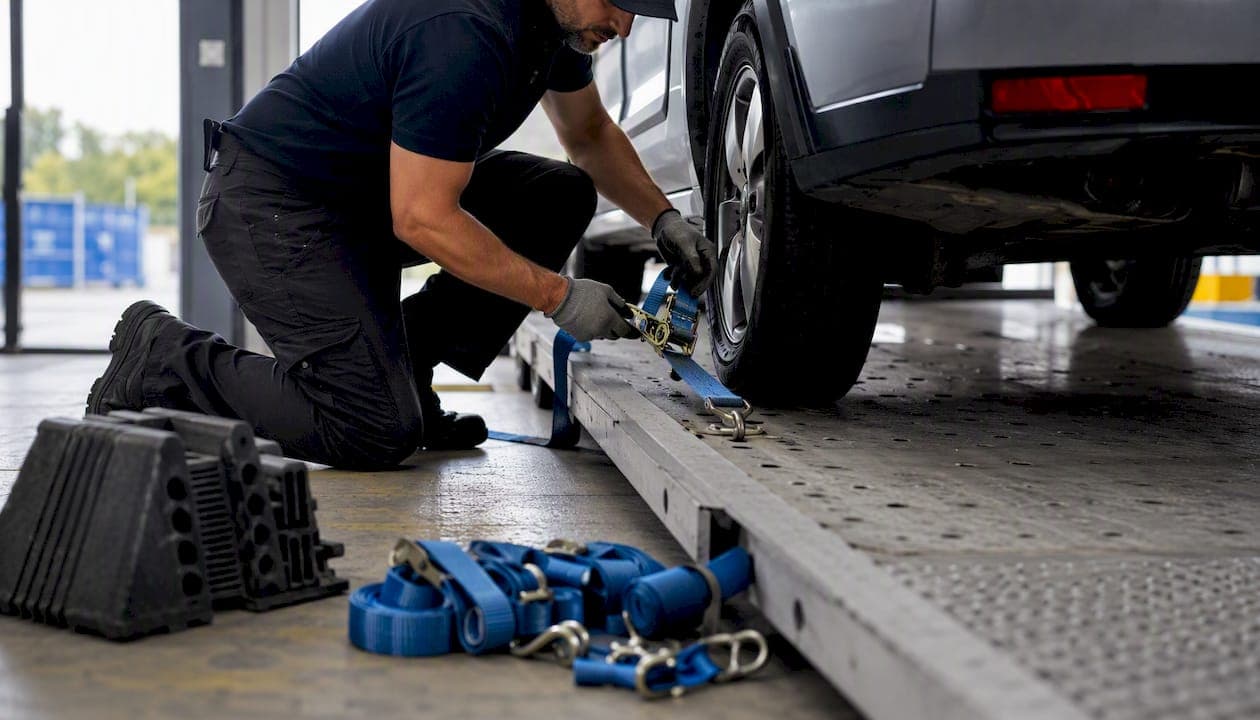
UK car transport typically costs between £150 and £600, depending on distance, transport method, and your vehicle's condition. Short local moves under 50 miles often start around £100–£180, while long-haul routes of 300 miles or more can push past £600 for enclosed or specialist transport. Per-mile rates run roughly £1.05–£3.20, with shorter jobs costing more per mile because fixed handling costs don't spread as far. The single fastest way to get an accurate number for your specific route is to compare multiple UK quotes through Swiftroute-courier, which pulls offers from pre-approved carriers in one place.
Distance moves the needle most, but it's not the only variable. Whether your car runs, what size it is, and how quickly you need it collected all shift the final price. The sections below break down every factor with worked examples so you can estimate your own move before you request a single quote.
Key Takeaways
| Point | Details |
|---|---|
| Typical UK price range | £100–£180 for short runs under 50 miles; £280–£600+ for long-haul routes over 300 miles. |
| Per-mile rate trend | Rates run roughly £1.05–£3.20/mile; shorter jobs cost more per mile because fixed handling costs don't spread as far. |
| Biggest cost levers | Distance, transport method (open vs. enclosed), vehicle condition, and lead time at booking drive most of the price variance. |
| Booking timing matters | Booking 2+ weeks out can save £100–£130 versus same-week booking on a 300-mile route. |
| Swiftroute-courier | Compare verified UK carrier quotes in one place at Swiftroute-courier to get accurate, comparable prices fast. |
Table of Contents
- What does car transport cost in the UK by distance and method?
- What factors make your quote higher or lower?
- How to estimate what you'll pay before getting a quote
- Practical ways to reduce your car transport cost
- Non-running vehicles, EVs, and other special cases
- What to check before you book a car transport quote
- How lead time affects transit times and price
- What experienced practitioners get wrong about car transport
- Swiftroute-courier makes comparing UK car transport quotes straightforward
- Sources
What does car transport cost in the UK by distance and method?
Pricing in the UK car shipping market works on three overlapping units: a flat minimum charge (most carriers won't go below £100–£120 even for very short runs), a per-mile rate that decreases as distance grows, and service-level premiums layered on top. Per-mile rates fall as distance increases because the fixed costs of pickup, loading, and paperwork get spread across more miles on a longer job.
The table below shows realistic 2026 market examples across three common distance bands and three service types. These are illustrative ranges drawn from current UK pricing guides, not guaranteed quotes.
A well-cited real-world example: London to Manchester (roughly 210 miles) typically prices at £250–£370 on an open carrier in current market conditions, with fuel costs and demand affecting spot pricing on any given week.
Key premiums to factor in on top of base rates:
- Enclosed transport: typically 40–60% above open-carrier pricing, reflecting fewer load slots and greater handling care. Carriers price it this way because a full enclosed trailer holds far fewer vehicles than an open transporter.
- Same-day or expedited collection: expect a surcharge of £50–£150 or more depending on carrier availability.
- Non-running vehicles: winching and specialist loading equipment add £50–£200 to most quotes.
- Rural or restricted-access addresses: narrow lanes or no-HGV zones often trigger a £30–£80 access fee.
- Fuel surcharges: many operators apply a variable fuel levy, especially on longer routes where diesel costs shift weekly.
What factors make your quote higher or lower?
Most of the variance between two quotes for the same route comes down to a handful of inputs. Knowing which ones you can control helps you disclose the right information upfront and avoid surprise charges later.
- Distance: the single biggest cost driver. Additional mileage generally increases the quote by a moderate amount per 100 miles.
- Vehicle size and weight: a standard hatchback costs less to transport than a large SUV or pickup truck. Oversized vehicles may require specialist equipment or a dedicated slot.
- Running vs. non-running: a car that can't be driven onto the transporter needs a winch or forklift, which adds labor time and specialist gear.
- Transport method: open carrier is the most economical; enclosed adds a significant premium; driven delivery is cheapest but only suitable for roadworthy vehicles with a valid MOT.
- Collection and delivery location: city-center pickups are generally easier and cheaper. Remote postcodes, ferry crossings (e.g., Scottish islands), or addresses with access restrictions all push the price up.
- Lead time and urgency: booking two or more weeks out gives carriers time to consolidate loads, which keeps your price down. Last-minute or same-week bookings often carry a premium of 20–40%.
- Seasonality: summer and pre-bank-holiday periods see higher demand. January and mid-autumn tend to be quieter and cheaper.
Common surcharges to watch for on your quote:
- Winching fee (non-runner): £50–£200
- Low-clearance or modified vehicle handling: £30–£100
- Tail-lift or specialist ramp use: sometimes bundled, sometimes itemized
- Redelivery fee if no one is present at drop-off: £40–£80
- Rural-access or ferry supplement: varies widely
One point on insurance that many people overlook: most carriers include basic goods-in-transit cover, but the limit may be far below your vehicle's market value. Fuel-price volatility and shifting driver availability in 2026 have pushed many operators toward real-time quoting rather than fixed published rates, which means two quotes for the same route on different days can differ by £50–£100. Always confirm the declared value limit and whether you need to arrange top-up cover separately.
How to estimate what you'll pay before getting a quote
A simple formula gets you close enough to sanity-check any quote you receive:
Estimated cost = base fee + (miles × per-mile rate) + service premiums + access/extra charges
Assume a base fee of £80–£120 for most standard moves, a per-mile rate of £1.05–£1.50 for routes over 100 miles (higher for shorter runs), and then add any applicable premiums from the list above.
Three worked examples using real UK routes:
-
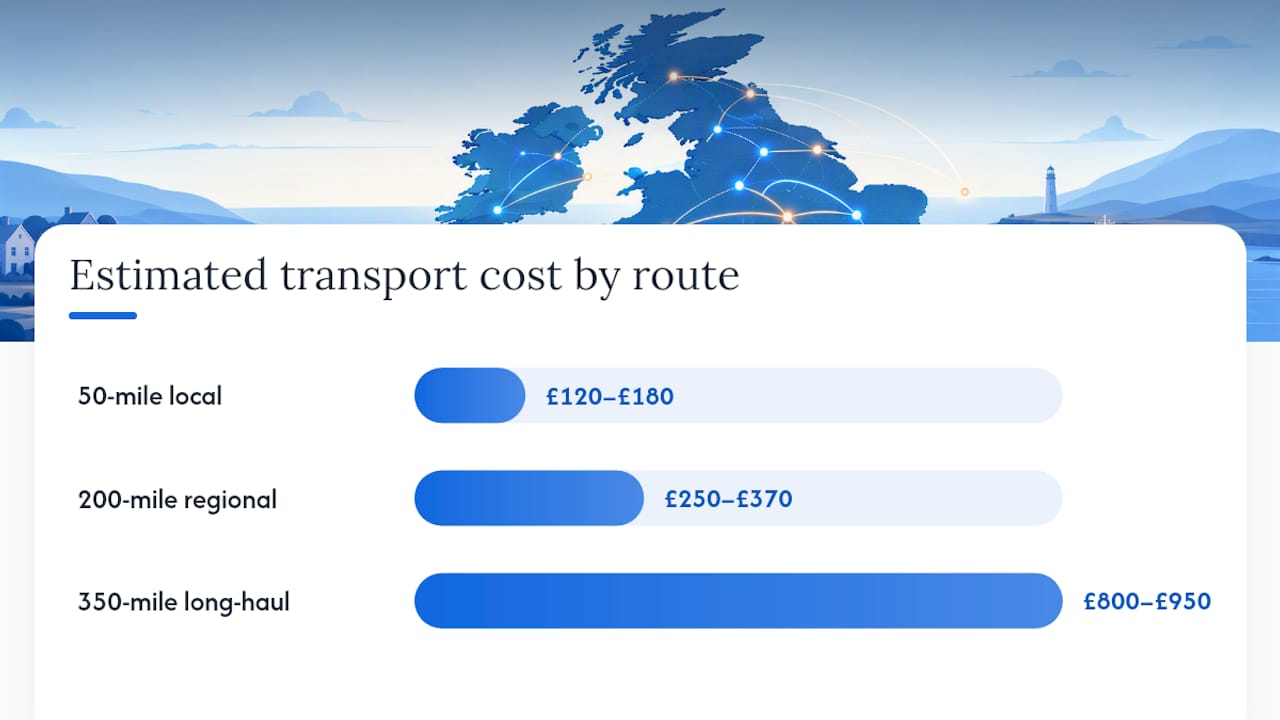
50-mile local move (e.g., Bristol to Bath area, open carrier, door-to-door, running vehicle) Base fee: £100. Miles: 50 × £1.60/mile = £80. Total before extras: £180. Fuel surcharge included in most short-haul quotes. No access issues. Estimated range: £120–£180.
-
200-mile regional move (e.g., Birmingham to Leeds, open carrier, door-to-door, running vehicle) Base fee: £100. Miles: 200 × £1.20/mile = £240. Total before extras: £340. Fuel surcharge typically bundled. No access issues. Estimated range: £250–£370. For Birmingham-area quotes, regional carriers often price this band competitively.
-
350-mile long-haul move (e.g., London to Edinburgh, enclosed carrier, non-running vehicle) Base fee: £120. Miles: 350 × £1.30/mile = £455. Winching fee: £100. Total: £903. Estimated range: £800–£950 for this combination of factors.
Pro Tip: These examples exclude tolls (e.g., Dartford Crossing, Mersey Tunnel) and ferry crossings. Ask your carrier to confirm whether tolls are included or billed separately — some quote net of tolls, others absorb them.
Insurance is also excluded from the formula above. Basic goods-in-transit cover is usually included, but the declared value cap varies by carrier. If your vehicle is worth more than £15,000–£20,000, ask specifically about the cover limit before you sign anything.
Practical ways to reduce your car transport cost
The biggest savings come from timing and flexibility, not from haggling on a quote you've already received.
- Book at least two weeks out. Carriers filling a transporter with multiple vehicles spread fixed costs across the load. A last-minute single-vehicle booking gives them no room to do that, so you pay more.
- Choose terminal-to-terminal over door-to-door. Dropping your car at a carrier's depot and collecting from their destination depot can cut £30–£80 off the price, depending on the route.
- Accept a delivery window rather than a fixed date. Giving the carrier a 2–4 day window lets them route your vehicle alongside others, which is how backload pricing works.
- Combine vehicles. Moving two cars at the same time, or sharing a transporter with another customer on the same route, reduces the per-vehicle cost. Some carriers offer a multi-car discount of 10–20%.
- Avoid peak periods. Late August, pre-Christmas, and bank-holiday weekends all see demand spikes. Mid-January and October tend to offer the best availability and pricing.
- Skip expedited unless you genuinely need it. Same-day or next-day collection adds a premium that rarely reflects a real service difference for most standard moves.
Pro Tip: *Ask carriers whether they have a backload or return-leg run on your route.
One honest warning: the cheapest quote is not always the best one. A price that looks significantly lower than every other quote usually means something is missing, whether that's adequate insurance cover, a licensed operator, or a realistic delivery window. Verify credentials before you commit.
Non-running vehicles, EVs, and other special cases
Non-running vehicles
A car that can't be driven onto a transporter under its own power needs winching or a forklift, and not every carrier has the right equipment. Expect to add £50–£200 to a standard quote for a non-runner, and confirm the carrier has the right gear before booking. Some specialist recovery operators charge at the higher end of that range for vehicles that are partially dismantled or have seized brakes.
- Winching fee: £50–£150
- Additional labor for a vehicle with no steering or brakes: £50–£100 extra
- Specialist flatbed or low-loader (for very low-clearance or damaged vehicles): may require a dedicated quote
Disclose the vehicle's condition accurately when requesting quotes. Carriers who discover a non-runner on collection day may refuse the job, charge a penalty, or add the winching fee on the spot at a higher rate than you'd have paid upfront.
Electric vehicles
EVs add a layer of complexity that affects both handling time and carrier eligibility. If the battery is depleted, it becomes a non-runner and attracts the same surcharges.
This sits safely within most carriers' requirements and avoids any non-runner classification.
Some carriers also flag that certain EV models with very low ground clearance or heavy battery packs require specialist ramps. Ask specifically whether the carrier has transported your model before.
Low-clearance, modified, and oversized vehicles
Sports cars with sub-100mm ground clearance, modified vehicles with body kits, and oversized pickups or vans often need specialist carriers or additional loading care. Expect a surcharge of £30–£100 for low-clearance handling, and for genuinely oversized vehicles, a dedicated flatbed may be the only option, which changes the pricing model entirely.

What to check before you book a car transport quote
Getting a low quote means nothing if the carrier isn't properly licensed, insured, or reliable. Run through this checklist before you hand over a deposit.
- What insurance cover is included? Ask for the declared value limit and the type of cover (goods-in-transit, motor trade, or third-party only). If the limit is below your vehicle's value, arrange top-up cover.
- Is the fuel surcharge included or added later? Some quotes are net of fuel; others bundle it. Confirm in writing.
- Are tolls included? Routes through the Dartford Crossing, Mersey Tunnel, or similar toll roads should be accounted for.
- What is the exact pickup and delivery window? "2–5 days" is not the same as a confirmed date. Get the window in writing.
- What are the cancellation and redelivery fees? Know what happens if you need to reschedule or if no one is present at delivery.
- Does the carrier hold an O-licence (Operator's Licence)? Any operator moving vehicles commercially in the UK should hold a valid O-licence. You can verify this through the DVSA's public register.
- Will photos be taken at collection and delivery? A reputable carrier documents the vehicle's condition at both ends. If they won't, that's a problem.
- For driven deliveries: use the Gov to verify the driver's licence status and entitlements before the vehicle leaves your hands. Also confirm the vehicle has a valid MOT — the nidirect MOT guidance explains how to check certificate status if you're unsure.
Red flags to walk away from:
- Cash-only payment with no receipt or written contract
- Vague or evasive answers about insurance cover
- No written confirmation of pickup/delivery windows
- Unusually large upfront deposit (more than 25–30% of the total)
- No evidence of an O-licence or company registration when asked
You can find vetted carriers through Swiftroute-courier's platform, where carriers go through a verification process before they can access job listings.
How lead time affects transit times and price
Transit times in the UK vary more than most people expect, and lead time at booking directly affects both availability and what you pay.
Typical transit windows by distance:
- Under 50 miles: same-day or next-day collection is usually possible; delivery within 1–2 days.
- 50–200 miles: 1–3 days from collection to delivery on most routes.
- 200–400 miles: 2–5 days, depending on carrier routing and load consolidation.
- 400+ miles or cross-border (e.g., mainland UK to Northern Ireland): 3–7 days, with ferry scheduling adding variability.
How lead time affects your price:
- Booking 2+ weeks out: carriers can plan loads efficiently. You get the best available rate and more carrier options.
- Booking 1 week out: still reasonable, but fewer carriers may be available for your specific route and date.
- Booking same-week or same-day: expect a 20–40% premium on the standard rate, and fewer choices on service level.
A concrete example: a 300-mile open-carrier move booked three weeks out might price at £320. The same move booked with two days' notice could come in at £420–£450, assuming a carrier is even available. That £100–£130 difference is entirely a function of timing, not the quality of the service.
What experienced practitioners get wrong about car transport
The most common mistake isn't choosing the wrong carrier. It's giving the carrier the wrong information at the point of quoting.
Customers who don't disclose a non-running vehicle, a modified suspension, or a remote collection address get a quote that doesn't reflect reality. The carrier then either refuses the job on the day or adds charges on the spot. Either way, the customer loses time and often money. Accurate disclosure upfront is the single thing that consistently produces quotes you can actually rely on.
The second mistake is treating the lowest quote as the benchmark and working backward from there. A quote that's £80 below every other offer almost always has a reason. Missing insurance cover, an unlicensed driver, or a delivery window that's really "whenever we get around to it" are the usual culprits. The right benchmark is the middle of a cluster of quotes from verified carriers, not the outlier at the bottom.
Pro Tip: When you request quotes, prepare the following before you start: vehicle make, model, and year; whether it runs and drives; collection and delivery postcodes; your preferred date range; and whether you need door-to-door or can use terminal-to-terminal. Carriers who receive complete information give more accurate quotes, and you can compare them like for like.
Swiftroute-courier makes comparing UK car transport quotes straightforward
Getting a realistic car transport price means collecting multiple quotes from verified carriers and comparing them on the same terms. Swiftroute-courier is built specifically for that job. Instead of calling five carriers individually and getting quotes in different formats, you submit one request and receive comparable offers from pre-approved UK operators, each showing pricing, ratings, and estimated delivery times side by side.
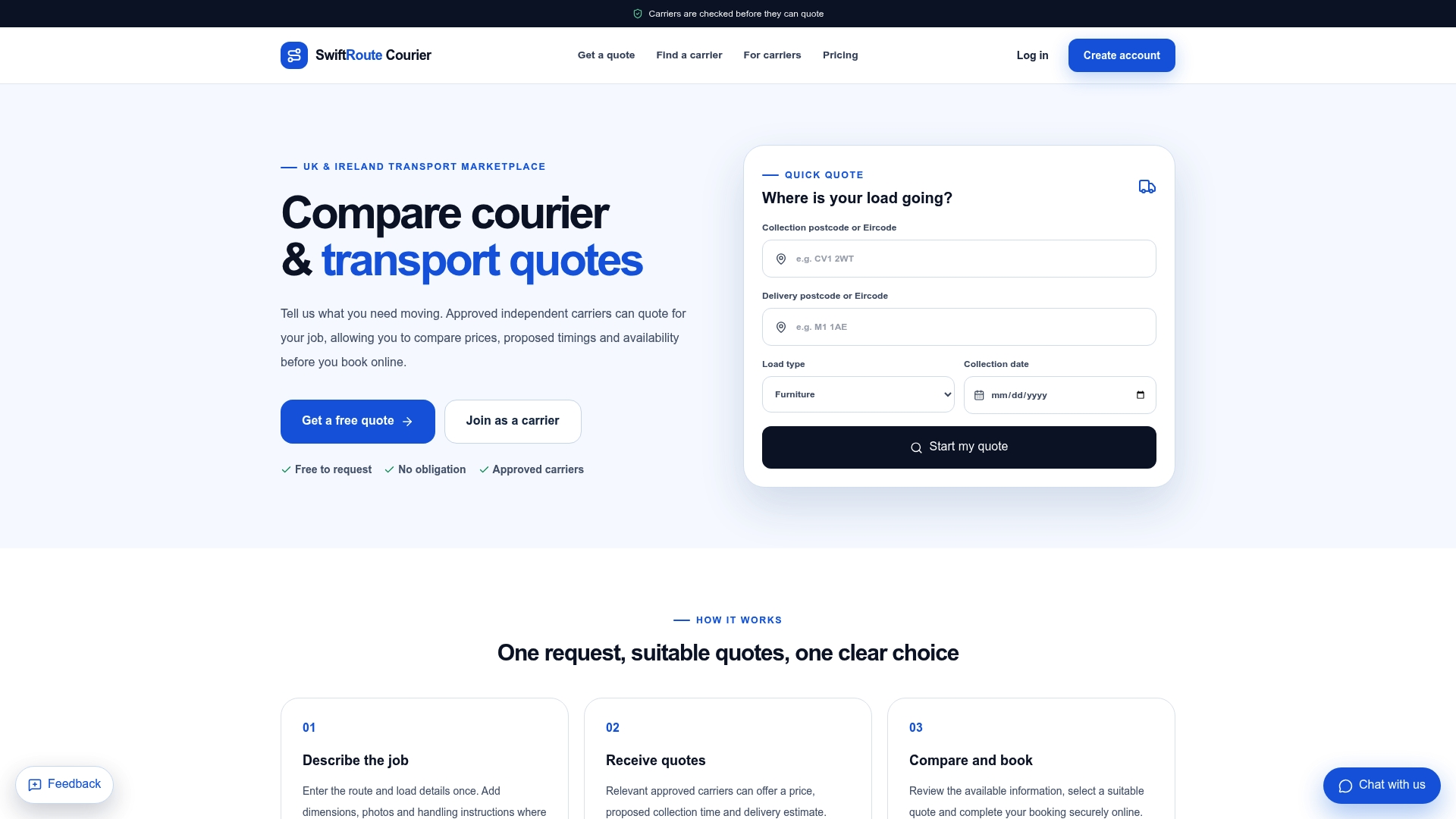
The platform covers the UK and Ireland, with regional quote pages that reflect local pricing signals rather than generic national averages. Carriers on the platform are verified before they can access jobs, which addresses the credential-checking step that most people skip when booking independently. There's no monthly fee to use the platform as a customer, and the dashboard keeps all your requests and quotes in one place.
To get started, have your vehicle details, postcodes, and preferred date range ready, then request your transport quotes through Swiftroute-courier. You'll see real offers from real carriers, with the information you need to make a confident decision.